
Seattle Rain and Garage Door Rust: What Corrodes First and What to Do About It
Rust on a garage door rarely announces itself. It shows up as a cable that frays near the floor, a bottom bracket that looks orange, a roller that squeals, or a spring that snaps a few years earlier than the cycle rating suggested. This post explains what Seattle's climate actually does to door hardware, where corrosion tends to appear first, and what a sensible maintenance rhythm looks like for a garage in Seattle, WA or anywhere else in King County.
The Garage Door Repair Seattle is a free quote service, not a garage door company. We don't do tune-ups or repairs. Independent local companies reply to your request with their own quotes, and some pay to receive those requests.
What the climate does, and what it doesn't
Sea-Tac averages 39.34 inches of rain and about 156 days a year with measurable rain, about two-thirds of it November through March; November is the wettest month at about 6.3 inches (NOAA 1991–2020 normals). What matters for a garage door isn't the inches so much as the days: hardware in an unheated garage sits in damp air for most of the winter, and water tracked in on tires pools along the bottom of the door.
What Seattle mostly doesn't have is ice. Sea-Tac averages only about 25 nights a year at or below freezing and about 6.3 inches of snow, so the Midwest problem of a door frozen to the slab is a minor angle here. Damp is the issue, not cold.
The door industry's own guidance is measured about it. DASMA's technical sheet on spring cycle life says rust reduces the effective area of spring wire, which reduces its strength, and that rust can cause corrosion pits from which fatigue cracks accelerate and shorten cycle life. It also says regular greasing or lubrication of springs, as the manufacturer's instructions require, helps a spring reach its rated cycles. No source we found ties Seattle's rain to a specific failure rate for springs, cables or rollers, so this post won't pretend one exists.
Where rust shows up first
Water runs downhill, so corrosion usually starts at the bottom of the door and works up. In rough order:
- Bottom brackets, where the lifting cables attach a few inches above a wet floor
- The bottom seal and its metal retainer, which hold moisture against the door
- The lowest hinges and rollers, splashed by tires and track runoff
- Cable ends and the first few inches of cable above the bracket
- Track bolts and the lower track, especially where it meets the slab
- Springs, which show surface rust early but usually fail later, from pitting plus fatigue
- The lowest steel section on a steel door, or the bottom rail on a wood door
The bottom bracket and the cable deserve special respect. Both are under the full tension of the springs whenever the door is closed. A bracket that's visibly rusted or a cable with broken strands isn't a cleanup job; it's a reason to request quotes and leave it alone until then. Torsion springs store enough energy to cause serious injury. Leave spring and cable work to a trained technician.
Why older Seattle garages see more of it
Seattle's median home was built in 1976, and 22.8% of the city's homes were built before 1940 (American Community Survey 2020–2024). Shoreline's median is 1969 and Burien's 1966. Many of those houses have a detached garage at the back of the lot or off an alley, often unheated, sometimes with a slab that's lower than the driveway so water runs in rather than out. Older hardware was also more often plain painted steel than the galvanized or coated parts common today. None of that means a 1950s garage has a doomed door. It means the bottom few inches deserve a look every autumn.
Wood doors have their own version of the problem. Water that rusts a bottom bracket also soaks the end grain of a wood bottom rail. The wood garage door rot post covers how to check for soft spots and when a rotted rail means repair or replacement.
What rust-related repairs cost
The repair depends on which part gave up. Published national guides give these planning ranges.
| Item | Typical range | Source |
|---|---|---|
| Tune-up | $120–$240 | This Old House, Mar 2026 |
| Cable repair | $100–$200 · $170–$320 | Fixr, Jan 2025 · This Old House, Mar 2026 |
| Spring replacement | extension $120–$250; torsion $200–$350 | Fixr, Jan 2025 |
| Spring replacement (second guide) | $300–$540 | This Old House, Mar 2026 |
| Off-track repair | $100–$300 | Fixr, Jan 2025 |
| Panel replacement (rusted-through section) | $150–$1,000 · $440–$725 | Fixr, Jan 2025 · This Old House, Mar 2026 |
| Service call / trip fee | $50–$75 | Fixr, Jan 2025 |
The Seattle garage door repair cost guide has the full table and a planning calculator. If a cable has already let go and the door is crooked in the opening, see the off-track repair page and don't operate the door.
A maintenance rhythm for a wet climate
What a homeowner can safely do
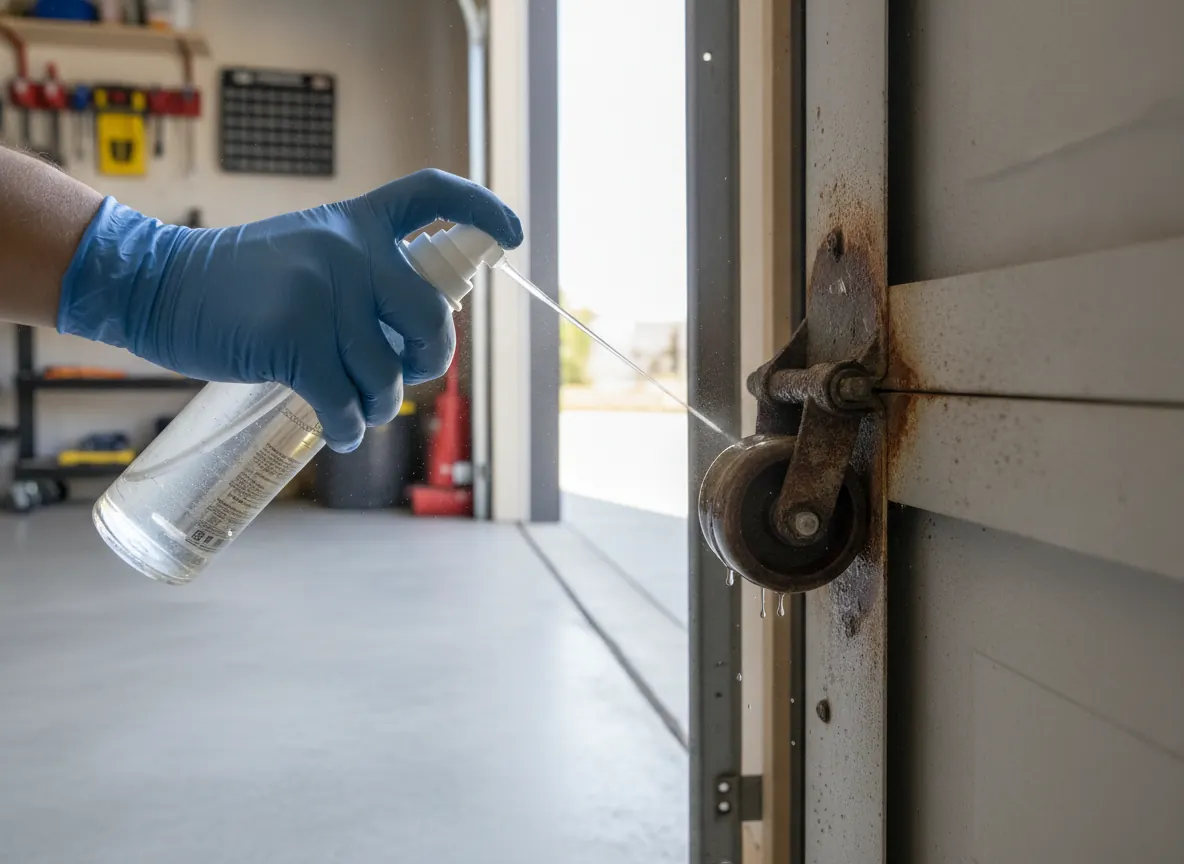
Once or twice a year, with the door closed and the opener unplugged, look at the bottom brackets, cables, rollers and hinges with a flashlight. Lubricate hinges, rollers and springs lightly with a product the door or opener manufacturer recommends, and wipe off drips. Keep the tracks clean and dry rather than greased. Sweep standing water away from the bottom of the door. Replace a cracked bottom seal so water stops wicking into the door. Don't adjust springs, cables or brackets; if any of those look wrong, stop and request quotes.
Many companies offer an annual tune-up that covers lubrication, hardware tightening, balance and auto-reverse checks, and a look at the parts you can't safely touch. This Old House puts a tune-up at $120–$240. Autumn, before the November rain starts in earnest, is a sensible time. Ask about galvanized or coated replacement hardware when parts are swapped, and ask whether the springs the company stocks have any corrosion-resistant finish. The garage door maintenance page goes through what a tune-up typically includes.
Two small habits help more than any product. Fix the drainage first: if water runs into the garage from the driveway, a bottom seal and a threshold strip can keep the floor around the brackets drier. And don't let a leaking downspout discharge beside the door jamb, which soaks the jamb, the track bolts and the bottom bracket on that side.
Before you book a tune-up or repair
Washington requires garage door companies to be registered with the Department of Labor & Industries (L&I) as contractors; there is an "Overhead/garage doors" specialty. Registered contractors carry a bond and liability insurance and must show their registration number in ads (RCW 18.27.100). Look any company up on L&I's Verify a Contractor tool. Ask for a written estimate that lists each part being replaced, the trip fee if any, and the warranty terms, and ask for the old parts back. If a technician recommends replacing springs that still look fine, ask them to show you the pitting or the broken strands.
To compare quotes for a tune-up, a cable or a spring, describe what you're seeing through the free quote form or call (877) 265-2390. A photo of the rusty part helps the companies reply with a more useful number. The spring repair page explains what happens on a spring visit if that's where the inspection leads.
Frequently asked questions
Does Seattle rain really rust garage door parts faster?
Sea-Tac averages about 156 days a year with measurable rain (NOAA 1991–2020), so hardware in an unheated garage spends months in damp air. The industry's DASMA technical sheet says rust reduces a spring's effective wire area and can seed fatigue cracks. No source gives a Seattle-specific failure rate, so treat it as a reason to inspect, not a prediction.
Which garage door parts rust first?
Usually the parts closest to the wet floor and the outside air: the bottom brackets, the bottom seal retainer, the lowest hinges and rollers, and the cable ends where they attach near the floor. Springs show surface rust early but tend to fail later, from pitting plus cycle fatigue.
Can I lubricate a rusty garage door spring myself?
Light lubrication of springs, hinges and rollers with a product the opener or door manufacturer recommends is normal homeowner maintenance. Wipe off drips, and avoid the tracks. Don't adjust, loosen or touch the spring hardware, cables or bottom brackets; those are under tension.
What does rust-related garage door repair cost?
It depends on what corroded. Published national guides put cable repair at $100–$200 (Fixr, Jan 2025) or $170–$320 (This Old House, Mar 2026), spring replacement at $120–$540 across both guides, and a tune-up at $120–$240. Seattle-area quotes vary, so compare written estimates.