
Wood Garage Door Rot: Repair, Reface or Replace? A Seattle, WA Guide
Peeling paint along the bottom of the door, a corner that gives when you press it, a door that sticks every January. On a wood garage door in Seattle, WA, those are the early signs of rot. This guide covers where rot starts, how to check for it, and how to weigh the three choices: repair the rail, reface the door, or replace it.
The Garage Door Repair Seattle is a free quote service, not a garage door company. We don't repair or install doors. Independent companies serving Seattle and King County reply to your request with their own quotes, and some pay to receive those requests.
Why wood garage doors are common in Seattle
Seattle's housing is old by West Coast standards. The city's median home was built in 1976, and 22.8% of its homes date from before 1940 (American Community Survey 2020–2024), compared with about 11% for King County as a whole. Historic Seattle dates the Craftsman building boom to the years just after the 1909 Alaska-Yukon-Pacific Exposition, when streetcar neighborhoods like Wallingford, Ravenna, Mount Baker, West Seattle, Phinney Ridge and Greenwood were platted (KUOW). Many of those houses have a detached single-car garage off an alley or at the back of the lot, and a wood door, whether original, a 1970s replacement, or a newer carriage-style wood door chosen to match the house, is a natural fit.
Wood also costs the most to replace. Fixr lists wood door materials alone at $1,000–$3,500 for a single door and $2,000–$6,000 for a double, more than any other material it tracks. That's why the repair-or-replace question matters more for wood.
Where rot starts
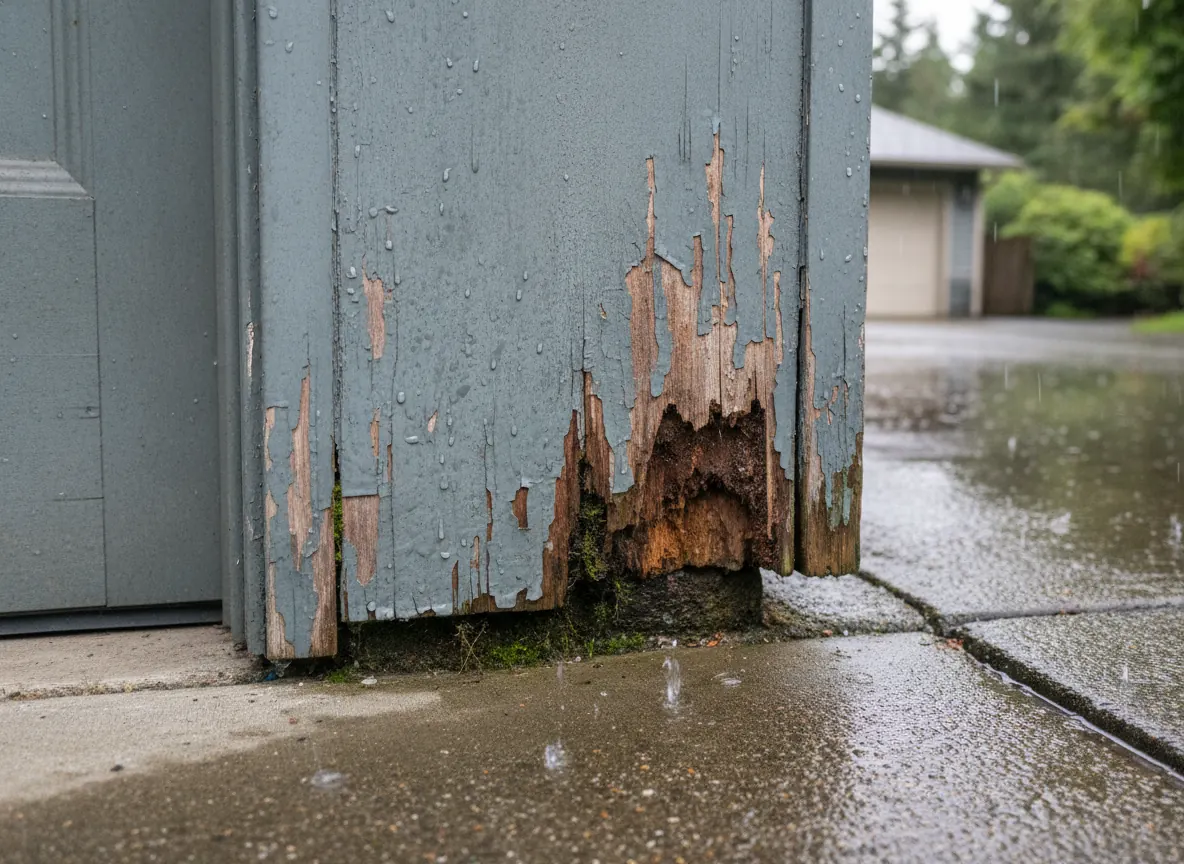
Water does the damage, and water collects at the bottom. The usual pattern:
- The bottom rail, especially the lower edge and the end grain at each corner
- The lower ends of the vertical stiles, where they meet the bottom rail
- Behind peeling or cracked paint anywhere a horizontal surface holds water
- Around the bottom seal, where an old seal traps moisture against the wood
- Panels in the lowest section of a sectional wood door
Seattle's climate helps it along. Sea-Tac averages about 156 days a year with measurable rain, two-thirds of it November through March (NOAA 1991–2020 normals). A bottom rail sitting a quarter inch above a wet slab all winter wicks water into its end grain. A sprinkler that hits the door, or a downspout beside the jamb, does the same job in summer.
How to check a wood door for rot
You need a flashlight and an awl or thin screwdriver. With the door closed, press the tip gently into the bottom rail every foot or so and into each lower corner. Sound wood resists; rotted wood takes the point easily and may feel spongy. Look for bubbled paint, dark staining and gaps opening between rail and stile. Then watch the door run. A door swollen with water can drag in the tracks or push a roller out of line, which is how rot turns into an off-track repair.
Keep your hands away from the cables, bottom brackets and springs while you look. Torsion springs store enough energy to cause serious injury. Leave spring and cable work to a trained technician.
Option 1: repair the rail or the bottom section
If the rot is limited to the bottom rail or one corner and the rest of the door is sound and square, repair is usually the economical choice. Small soft spots can be dug out, treated with an epoxy consolidant, filled and repainted. A rail that's gone soft along its length can be cut out and replaced. On a sectional wood door, the whole bottom section can sometimes be replaced, which is where the published panel-replacement ranges come in: $150–$1,000 (Fixr, Jan 2025) or $440–$725 (This Old House, Mar 2026).
Ask what's included. A new bottom section usually means a new bottom seal and retainer, and often new bottom brackets if the old ones are rusted. If the door's weight changes, the springs may need rebalancing, which should be its own line on the estimate.
Option 2: reface or clad the door
Some companies offer to reface a sound wood door with new exterior boards or a composite overlay, keeping the frame, hardware and opener. It only makes sense if the frame has been checked and is dry and solid; cladding over rot hides the problem and adds weight. Treat it as a cosmetic option for a healthy door, not a cure for a rotten one.
Option 3: replace the door
Replacement is the honest answer when rot has reached the stiles or more than one section, when the door has been repaired before, when it's racked out of square, or when the hardware and springs are at the end of their life anyway. Two paths:
- New wood door. Keeps the historic look and can be built to a non-standard opening. Highest material cost, and it needs a finish schedule the installer should spell out for you. Ask how often they recommend recoating in this climate.
- Insulated steel or composite carriage-style door. Wood-look panels, optional top windows, far less upkeep, and lighter, which is easier on springs and openers. Fixr puts a new single steel door installed at $700–$2,000 and a double at $1,175–$4,075. Insulation helps in a damp, unheated detached garage.
| Item | Typical range | Source |
|---|---|---|
| Panel replacement | $150–$1,000 · $440–$725 | Fixr, Jan 2025 · This Old House, Mar 2026 |
| Off-track repair (swollen door) | $100–$300 | Fixr, Jan 2025 |
| New single steel door, installed | $700–$2,000 (avg ≈ $993) | Fixr, Jan 2025 |
| New double door, installed | $1,175–$4,075 | Fixr, Jan 2025 |
| Wood door, materials only (single · double) | $1,000–$3,500 · $2,000–$6,000 | Fixr, Jan 2025 |
| Service call / trip fee | $50–$75 | Fixr, Jan 2025 |
The Seattle garage door repair cost guide has the full table and a planning calculator. The panel replacement and wood door repair page explains what a technician typically does on a section swap, and the installation page covers sizes, insulation and design-pressure labels for a new door.
Permits, HOAs and contracts
Most garage door repairs don't need a permit, but a new or resized opening, or new wiring for an opener, usually does. Seattle exempts minor repairs under $6,000 in six months that don't touch load-bearing framing; Bellevue, WA and King County exempt same-size door replacement; Issaquah requires a permit even for in-kind replacement (MyBuildingPermit tip sheet, June 2026). Exemptions may not apply on steep-slope or shoreline lots. Ask your installer or call your city's permit center.
Many Eastside and plateau neighborhoods have HOAs with architectural review. Issaquah Highlands, for example, requires an application before changing a garage door's style or color but not for a same-style, same-color replacement (IHCA FAQ). Check your own CC&Rs.
Signing at home? Read the cancellation notice
If you finance a new door or opener through a contract signed at your home, Washington's Retail Installment Sales Act (RCW 63.14.154) and the FTC's Cooling-Off Rule can give you until midnight of the third business day to cancel, by certified mail under the state law. Repairs you called a company out for are generally treated differently. Look for the cancellation notice before you sign. For jobs of $1,000 or more, the contractor must also give you a written "Notice to Customer" before work starts (RCW 18.27.114). This is general information, not legal advice.
Washington requires garage door companies to be registered with the Department of Labor & Industries (L&I) as contractors. Look the company up on L&I's Verify a Contractor tool, get a written estimate for each option you're weighing, and ask for an itemized invoice when the work is done. To compare quotes on repair versus replacement, describe the door through the free quote form or call (877) 265-2390. A photo of the bottom rail helps.
Frequently asked questions
Can a rotted wood garage door be repaired?
Often, if the rot is limited to the bottom rail or a corner. Options include epoxy consolidant and filler for small soft spots, a new bottom rail, or replacing one bottom section on a sectional wood door. Once rot has spread into the stiles or more than one section, most companies will talk about replacement.
How much does it cost to replace a wood garage door?
Fixr (Jan 2025) lists wood door materials alone at $1,000–$3,500 for a single and $2,000–$6,000 for a double, before installation and removal. A new single steel door installed runs $700–$2,000 and a double $1,175–$4,075. These are published national estimates, not quotes; Seattle-area prices vary.
Is a steel carriage-style door a good substitute for wood?
For many older Seattle houses, yes. Insulated steel or composite doors with carriage-style panels and windows keep the look of a wood door with far less upkeep, and they're lighter, which matters for springs and openers. Wood still wins where a historic look or a custom size is the priority.
Do I need a permit to replace a wood garage door in Seattle?
Most garage door repairs don't need a permit, but a new or resized opening, or new wiring for an opener, usually does. Seattle exempts minor repairs under $6,000 in six months that don't touch load-bearing framing. Exemptions may not apply on steep-slope or shoreline lots. Ask your installer or call your city's permit center.