
Garage Door Safety Sensor Repair in Seattle, WA
A door that reverses for no reason, or one that doesn't reverse when it should, usually comes down to the two photo eyes near the floor or the opener's force setting. Here is how the system works, what a technician checks, and what published prices look like before you compare quotes from independent companies in Seattle, Washington.
Get a Free Quote Call (877) 265-2390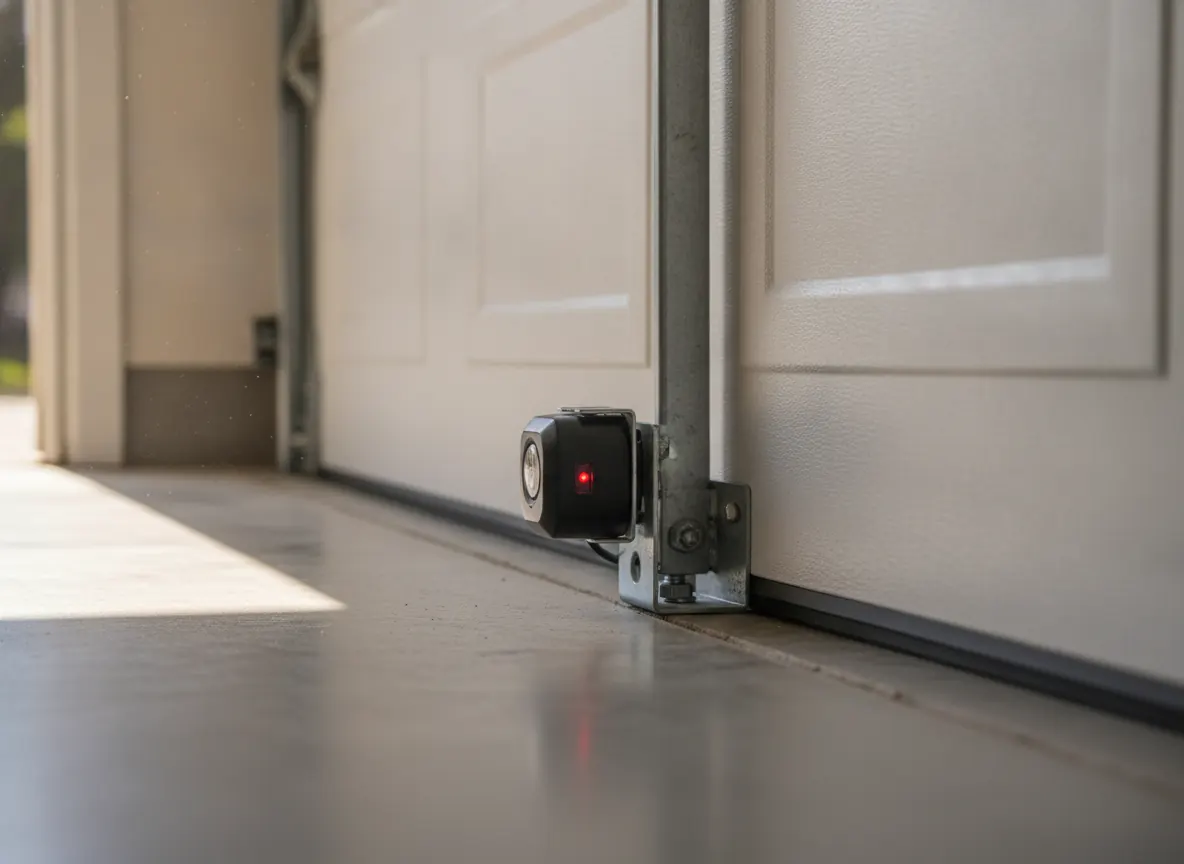
Signs the safety system needs attention
Some of these are nuisances. The last two are the reason the system exists.
- The door starts down, stops and goes back up with nothing in the way
- The opener light blinks after a failed close
- One sensor's LED is off, dim or flickering
- The door closes only while someone holds the wall button down
- A sensor bracket is bent or the wire is pinched or hanging loose
- The door touched a car, a bin or a bike and kept pushing
- The door failed the 2×4 test
The Garage Door Repair Seattle is a free quote-matching service, not a garage door company. You describe the job once, independent local garage door companies reply with quotes, and the company you choose does the work.
What a technician typically does
Methods vary by company. A sensor visit is usually quick, and it should end with a test you can watch.
1. Check alignment and LEDs
Both photo eyes should face each other with steady indicator lights. A bump from a bin is the most common cause.
2. Clean and inspect
Lenses cleaned, brackets straightened, and the low-voltage wire traced back for pinches, staples or corroded terminals.
3. Test force and travel
The opener's down-force and travel limits are checked so the door reverses on contact instead of pushing through.
4. Repair or replace
A failed sensor pair is replaced with a set matched to the opener. If the opener can't support photo eyes, replacement is quoted separately.
5. The 2×4 test
Auto-reverse is tested against a board on the floor and the beam is tested with a hand. Ask to watch both.
What 16 CFR 1211 requires, and what it doesn't
The federal safety standard for residential garage door openers, 16 CFR Part 1211, applies to openers made on or after January 1, 1993. A downward-moving door must reverse within 2 seconds of contact with an obstruction, and the opener must have a secondary entrapment protection system. On most openers that is a pair of photo eyes, but an edge sensor or an equivalent device also complies. The standard also requires the red manual release handle (16 CFR 1211.9).
It does not require photo eyes specifically, and it does not create an inspection program for homes; it governs what manufacturers may sell. CPSC's guidance covers the homeowner's side: inspect the door and opener every 30 days, test the auto-reverse monthly with a 2×4 laid flat in the door's path, and if the door does not reverse, disengage the opener until it is adjusted, repaired or replaced. CPSC also recommends mounting photo eyes 4 to 6 inches above the floor.
Never bypass the sensors
Taping a sensor to point at its partner, or wiring the pair together, defeats the only system that stops the door when a child or a pet is under it. Holding the wall button to force a close is a one-time override, not a workaround.
Older openers and damp garages
Seattle's median home was built in 1976, Shoreline's in 1969 and Burien's in 1966 (American Community Survey 2020–2024). Openers last about 10 to 15 years (Fixr), so most have been replaced at least once, but a 1980s chain-drive unit still turns up in detached garages in Rainier Valley, Northgate and Wallingford. An opener from before 1993 may have no photo eyes and no way to meet the 2-second rule; companies generally recommend replacing rather than retrofitting it. Opener repair and installation in Seattle covers repair versus replace and battery backup.
Damp is the other local factor. Sea-Tac averages about 156 days a year with measurable rain (NOAA 1991–2020 normals), and in an unheated garage that can mean condensation on sensor lenses on cold mornings and corrosion at wire terminals over a few winters. A sensor that works by afternoon and fails at 7 a.m. in January is worth mentioning when you request quotes.
A garage door company doesn't need an electrical license for an opener's low-voltage sensor and wall-button wiring (WAC 296-46B-901). A new outlet or circuit for an opener is electrical work for a licensed electrical contractor, with a permit from your city (Seattle, Bellevue, Kirkland, Redmond, Renton, Sammamish, Burien, Tukwila, Lynnwood) or from L&I (Shoreline, Kent, Edmonds, Issaquah).
What sensor and auto-reverse work costs
Sensor work is billed as opener repair in the national guides. These figures are a baseline for reading written estimates, not prices from any Seattle company.
| Item | Typical range | Source |
|---|---|---|
| Opener repair | $100–$300 | Fixr, Jan 2025 |
| Opener, installed | $300–$600 (avg ≈ $480) · $430–$730 | Fixr, Jan 2025 · This Old House, Mar 2026 |
| Battery backup added to an opener | $75–$175 | Fixr, Jan 2025 |
| Service call / trip fee | $50–$75 | Fixr, Jan 2025 |
Published national estimates, not quotes (Fixr, Jan 2025; This Old House, Mar 2026). Seattle-area quotes vary.
A realignment sits at the low end of the opener-repair range, a new sensor pair in the middle, and an opener too old to support sensors becomes an installation quote. If a technician recommends a new opener, ask what the old one can't do. The Seattle garage door cost guide has the full table and a calculator.
Where the sensors fit in the bigger picture
Photo eyes and auto-reverse protect against entrapment by the opener. They do nothing about a broken spring or a snapped cable. Torsion springs store enough energy to cause serious injury. Leave spring and cable work to a trained technician. A sensor visit is a good time to ask for a balance check; see garage door maintenance in Seattle for what a full tune-up covers.
When a sensor problem is urgent
A door that won't close at all leaves the garage open, which matters most on an alley. A door that closed on something and did not reverse should not be run by the opener until it is fixed. Flag both as urgent. Some local companies offer evening, weekend or emergency service, often at a higher rate (Fixr: +$100–$300). Mention urgency on your request and ask about after-hours fees before work starts.
Questions to ask the companies that reply
Washington requires garage door companies to be registered with the Department of Labor & Industries (L&I) as contractors; there is an "Overhead/garage doors" specialty. Registered contractors carry a bond (at least $15,000 for a specialty contractor, $30,000 for a general contractor) and liability insurance, and must show their registration number in ads (RCW 18.27.100). Look any company up on L&I's Verify a Contractor tool.
- What is your L&I registration number?
- Is the trip fee separate from the repair, and is it waived if I go ahead?
- Can the estimate say whether the fix is alignment, a new sensor pair or a new opener, each priced separately?
- Will you show me the 2×4 test and the beam test before you leave?
- Will the invoice list the parts replaced, and can I keep the old sensors?
- What warranty terms apply to the sensors and the labor, in writing?
Safety sensor questions
Why does my garage door go back up when I try to close it?
Most often the photo eyes near the floor are blocked, dirty or out of line, and the opener treats that as an obstruction. Check for a rake handle or a leaf in the beam and that both sensor lights are steady. If the door still reverses, the sensors, their wiring or the opener's force setting need a technician.
Are photo eye sensors required by law on garage doors?
Not in those words. Under the federal standard 16 CFR 1211, residential openers made on or after January 1, 1993 must reverse within 2 seconds of touching an obstruction and must have a secondary entrapment system, which on most openers is a pair of photo eyes. An edge sensor or equivalent device also meets the standard. The rule governs manufacturers; nobody inspects homes for it.
How do I test the auto-reverse?
CPSC advises a monthly test: lay a 2×4 flat on the floor in the door's path and close the door with the opener. The door should reverse when it touches the board. If it doesn't, CPSC says to disengage the opener until it is adjusted, repaired or replaced. Also wave a hand through the photo eye beam while the door is closing; it should reverse at once.
My opener is from before 1993. Can sensors be added?
Sometimes, but many older openers have no terminals for photo eyes and no way to meet the 2-second reversal requirement. Companies usually recommend replacing an opener that old; Fixr (Jan 2025) lists installed openers at $300–$600 and This Old House (Mar 2026) at $430–$730.
Does a technician need an electrical license to fix sensor wiring?
A garage door company doesn't need an electrical license for an opener's low-voltage sensor and wall-button wiring (WAC 296-46B-901). A new outlet or circuit for an opener is electrical work for a licensed electrical contractor, with a permit from your city (Seattle, Bellevue, Kirkland, Redmond, Renton, Sammamish, Burien, Tukwila, Lynnwood) or from L&I (Shoreline, Kent, Edmonds, Issaquah).
Get free quotes for sensor and auto-reverse repair
Describe the problem once and independent companies serving Seattle, WA and nearby cities can reply with no-obligation quotes. Helpful details:
- What the door does when you try to close it
- Whether one or both sensor lights are on
- The opener's brand and rough age, if you know it
- Whether the door closed on something and did not reverse
Garage door stuck, loud or off track? Get free quotes.
Describe the problem once and independent garage door companies serving Seattle and the Eastside can reply with no-obligation quotes.