
Noisy Garage Door in Seattle: What the Sound Is Telling You
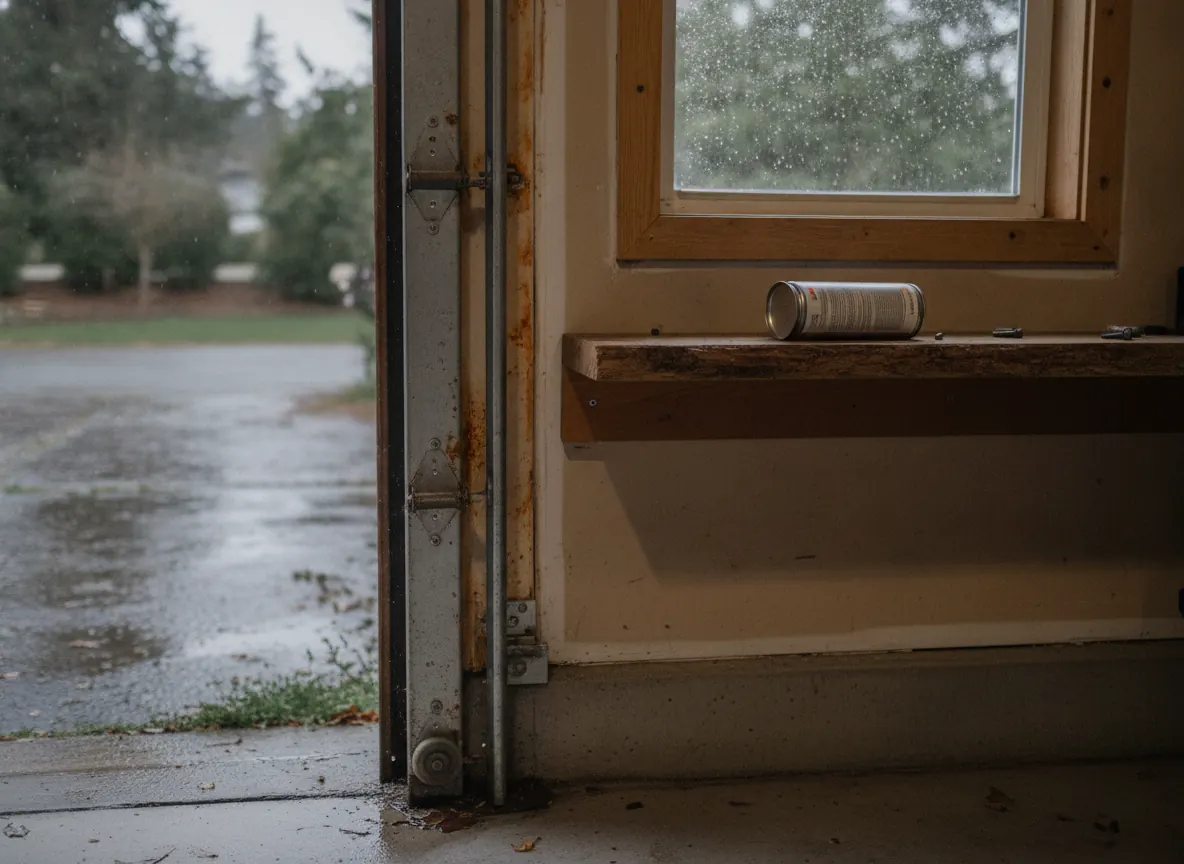
A noisy garage door is usually pointing at something small: dry springs, worn rollers or loose hardware. DASMA, the garage door manufacturers’ trade association, says squeaking springs come from normal use and don’t necessarily mean a problem, and suggests a spray-on garage door lubricant before calling anyone. If the noise comes back, or the door also feels heavy, jerks or binds, have a local company look at it. In a Seattle, WA garage that sees about 156 wet days a year, the noise often starts sooner than owners expect.
Why Seattle garage doors get noisy
Sea-Tac averages 39.34 inches of rain a year and about 156 days with measurable rain, roughly two-thirds of it from November through March (NOAA 1991–2020 normals). November is the wettest month at about 6.3 inches. A detached garage off the alley, or an unheated attached one, sits in that damp air all winter.
Damp air matters for the moving parts. DASMA’s technical sheet on spring life says rust reduces the effective area of spring wire and that corrosion pits can let fatigue cracks grow. The same sheet says regular lubrication, as the manufacturer’s instructions require, helps springs reach their full life. Dry, lightly rusted steel rubbing on steel is where most squeaks and groans begin. Our guide to Seattle rain and garage door rust covers which parts usually rust first.
Age adds to it. The city of Seattle’s median home was built in 1976, Shoreline’s in 1969 and Burien’s in 1966 (American Community Survey 2020–2024). Springs are commonly rated around 10,000 cycles, or roughly 9 to 10 years at three cycles a day, and most openers last about 10 to 15 years (Fixr). Many doors on older houses are on their second or third set of springs. Homes in Issaquah and Sammamish are newer (median 2002 and 1994), but a lot of those doors are now old enough for original springs and openers to wear.
Matching the garage door noise to the part
| What you hear | Where it usually comes from | First step |
|---|---|---|
| Squeak or chirp near the top of the door | Springs or hinges | Spray-on garage door lubricant (DASMA) |
| Rumble or rattle as the door travels | Rollers, hinges, loose track bolts | Look for worn or wobbling rollers; get a tune-up quote |
| Grinding or straining from the ceiling unit | The opener | Opener repair or replacement quote |
| A loud bang, or the door suddenly feels heavy | Possibly a spring or cable | Stop using the door and call a company |
Rollers. In a 2007 DASMA article, a door manufacturer’s research director said nylon rollers are “a lot quieter than steel rollers,” and that a ball-bearing metal roller can adjust to a slightly misaligned hinge. He also said doors over about 250 pounds may need upgraded bushings and rollers. That matters for the heavy wood doors common on older Seattle houses. It is an older, manufacturer-voice source, so treat it as a question to ask, not a rule.
The opener. A belt or chain opener near the end of its 10 to 15 year life can get louder as it wears. Our garage door opener repair page explains repair versus replacement.
What you can do about a noisy garage door yourself
- Use a spray-on lubricant made for garage doors on the springs, hinges and roller bearings, as DASMA suggests.
- Run the door a few times and listen again.
- Do the monthly checks CPSC recommends: look the door and opener over every 30 days, and test the auto-reverse with a 2x4 laid flat in the door’s path.
Leave springs and cables alone. DASMA says to leave high-tension spring and cable work to trained technicians. Torsion springs store enough energy to cause serious injury. CPSC warns that an unbalanced door could unexpectedly crash to the floor, and that doors that bind or stick should be serviced by a professional. If you need to check the balance, pull the red emergency release only with the door fully closed.
When a noisy door needs a garage door company
Lubricant fixes a dry squeak. It doesn’t fix a worn roller, a door that is out of balance or a tired opener. Ask for quotes if:
- the noise comes back within days of lubricating;
- the door jerks, binds or stops partway;
- you see a gap in a spring coil or a frayed cable (see garage door spring repair);
- the door fails the 2x4 reverse test (see safety sensor repair).
A noisy door that still opens, closes and reverses normally can wait for a regular daytime visit. For most homes, a garage door tune-up is the job that deals with dry hinges, worn rollers and loose hardware in one visit.
What fixing a noisy garage door can cost
These are published national estimates, not quotes (Fixr, Jan 2025; This Old House, Mar 2026). Seattle-area quotes vary.
| Item | Typical range | Source |
|---|---|---|
| Tune-up | $120–$240 | This Old House, Mar 2026 |
| Opener repair | $100–$300 | Fixr, Jan 2025 |
| Spring replacement | extension $120–$250; torsion $200–$350 | Fixr, Jan 2025 |
| Service call / trip fee | $50–$75 | Fixr, Jan 2025 |
See the full garage door repair cost guide for other jobs. Before work starts, look the company up on L&I’s Verify a Contractor tool, and ask for the price and any trip fee in writing, plus an itemized invoice listing the parts replaced.
Noisy garage door questions
Is a squeaky garage door a sign something is broken?
Not necessarily. DASMA says squeaking springs are caused by normal use. Try a spray-on garage door lubricant first, and call a company if the noise persists or the door feels heavy, jerks or binds.
Will nylon rollers make my garage door quieter?
A manufacturer’s research director quoted by DASMA in 2007 said nylon rollers are a lot quieter than steel rollers. Doors over about 250 pounds may need upgraded bushings and rollers, so ask the company quoting the job which type suits your door.
How much does it cost to fix a noisy garage door?
It depends on the cause. Published national estimates put a tune-up at $120 to $240 (This Old House, March 2026) and opener repair at $100 to $300 (Fixr, January 2025). Seattle-area quotes vary, so ask for the price and any trip fee in writing.
If lubricant hasn’t settled the noise, describe what you hear once and let independent local companies reply. Get free quotes from garage door companies in Seattle, Shoreline and the Eastside, or call (425) 738-3868.