
Garage Doors for Craftsman Bungalows and Detached Alley Garages in Seattle, WA
Seattle's Craftsman bungalows came with a garage sized for a Model T, not a crossover. The opening is narrow, the ceiling is low, the only way in is an alley, and the slab has settled over a century. This guide covers what makes these garages different, whether to repair the old door or replace it, what a new door for an odd-sized opening involves, and the Seattle, WA permit and electrical notes that come with the job.
The Garage Door Repair Seattle is a free quote service, not a garage door company. We don't install doors. Independent companies serving Seattle and King County reply to your request with their own quotes, and some pay to receive those requests.
A short history of the alley garage
Historic Seattle's Larry Kreisman dates the city's Craftsman boom to the years just after the 1909 Alaska-Yukon-Pacific Exposition, when streetcar suburbs were platted and the population tripled between 1900 and 1910 (KUOW). Wallingford, Ravenna, Mount Baker, West Seattle, Phinney Ridge and Greenwood filled up with the results. Today 22.8% of Seattle's homes were built before 1940 and the median home dates to 1976 (American Community Survey 2020–2024).
Cars arrived during that boom, so many of these houses got a detached single-car garage on the alley or at the back of the lot. City historic-site records describe exactly that pattern. Nobody has counted how many survive, so this post says "many" and leaves it there.
What's different about these garages
- Narrow openings, often well under the 8 or 9 feet a modern single door assumes
- Low headroom, with rafters or a loft close above the opening
- Shallow depth, so a standard horizontal track may not fit
- Out-of-square openings after decades of settlement
- Older door types: one-piece tilt-up doors or swing-out carriage doors
- Alley access, with little room to maneuver and more bumped doors
- Damp and unheated, which is hard on wood doors and plain steel hardware
None of these rule out a modern door. They do mean careful measuring and a quote that's specific about track type, door size and what happens to the opening.
Repair the old door or replace it?
An original or mid-century wood door that's sound and square can be worth keeping. Rot at the bottom rail, a swollen door that binds in winter, or worn tilt-up hardware are all repairable up to a point. The wood door rot post covers how to check for soft wood, and the panel replacement page explains a section swap.
Replacement makes more sense when you want an opener and the old door can't take one, when the door has been patched more than once, when a bumped door has bent the track, or when the springs and hardware are due anyway. Doors in tight alleys meet bumpers more than most; the off-track repair page explains why a bumped door shouldn't be run until someone has checked the cables and rollers.
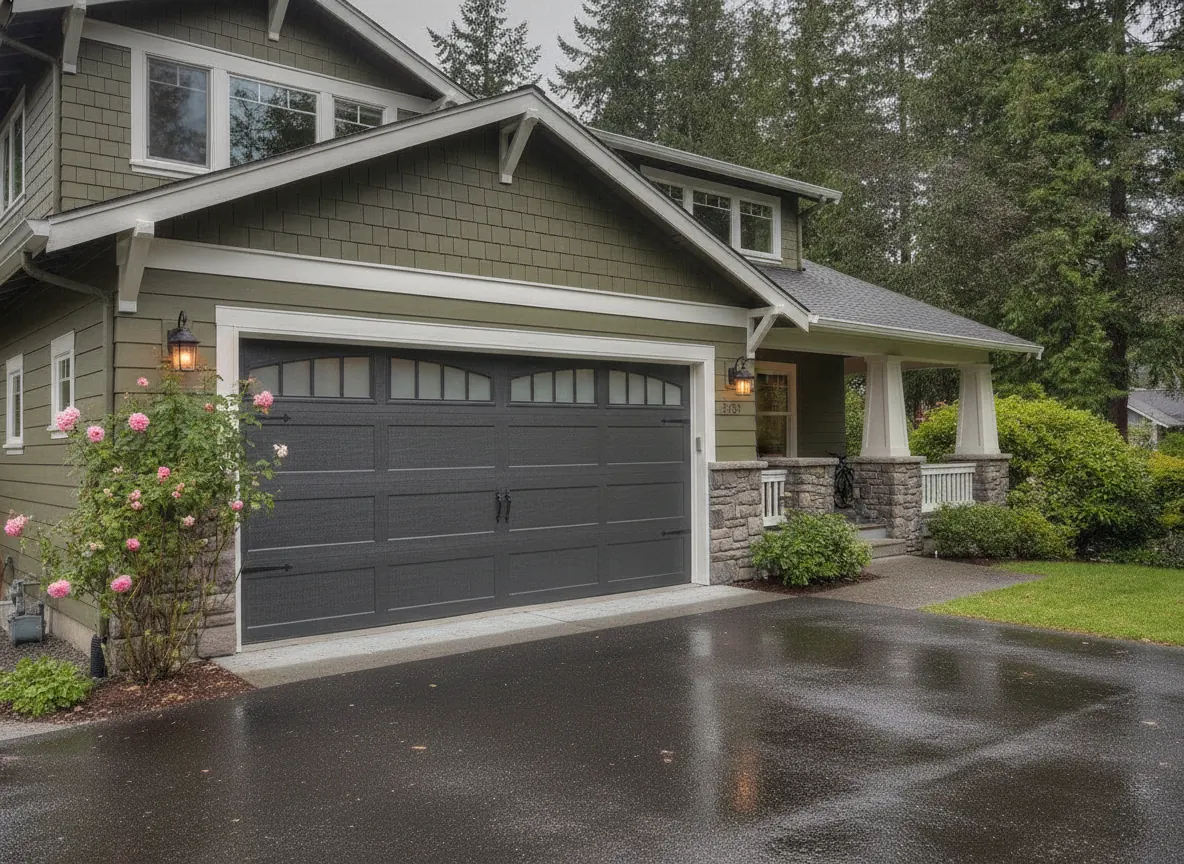
Choosing a new door for an old opening
Size. Many manufacturers build sectional doors to custom widths and heights. The installer measures the opening, the headroom, the side room and the depth into the garage. If the opening is too small for anything you'd want, the alternative is to change it, which is framing work and usually a permit.
Track. Low-headroom track kits let a sectional door run where a standard track won't fit, and they change where the springs and opener mount.
Style and material. Steel and composite carriage-style doors with wood-look panels and optional top windows are the usual choice for a Craftsman street. They're lighter than wood, which matters for springs and for an opener in a small structure. Wood remains the choice when a historic look or a very specific size is the priority, and it carries the highest material cost.
Insulation. An insulated door in a damp, unheated detached garage is quieter and stiffer, which helps a door opened by hand. Ask for the R-value and the weight.
Wind rating. New doors carry a design-pressure label. Ask the installer what your city requires and keep the label.
| Item | Typical range | Source |
|---|---|---|
| New single steel door, installed | $700–$2,000 (avg ≈ $993) | Fixr, Jan 2025 |
| Wood door, materials only (single) | $1,000–$3,500 | Fixr, Jan 2025 |
| Opener, installed | $300–$600 (avg ≈ $480) · $430–$730 | Fixr, Jan 2025 · This Old House, Mar 2026 |
| Battery backup added to an opener | $75–$175 | Fixr, Jan 2025 |
| Panel replacement | $150–$1,000 · $440–$725 | Fixr, Jan 2025 · This Old House, Mar 2026 |
| Off-track repair | $100–$300 | Fixr, Jan 2025 |
Custom sizes, low-headroom hardware and disposal of the old door sit on top of those figures. The Seattle garage door repair cost guide has the full table and a planning calculator, and the garage door installation page covers the measuring visit.
Openers in a detached garage
A detached garage that was wired decades ago may have one outlet on a long circuit from the house, or none at all. An opener plugged into an existing, working outlet is a door company's job. A new outlet or circuit for an opener is electrical work for a licensed electrical contractor, with a permit from your city (Seattle, Bellevue, Kirkland, Redmond, Renton, Sammamish, Burien, Tukwila, Lynnwood) or from L&I (Shoreline, Kent, Edmonds, Issaquah). In Seattle, the city's permit office issues electrical permits. A garage door company doesn't need an electrical license for an opener's low-voltage sensor and wall-button wiring (WAC 296-46B-901).
Low headroom also shapes the opener choice: a wall-mounted opener driving the torsion shaft directly can work where a ceiling rail won't fit. Battery backup is worth asking about; the November 19, 2024 windstorm knocked out power to more than 114,000 Seattle City Light customers, the utility's largest outage since 2006. The power outage post explains the manual release.
Permits and the settled slab
Most garage door repairs don't need a permit, but a new or resized opening, or new wiring for an opener, usually does. Seattle exempts minor repairs under $6,000 in six months that don't touch load-bearing framing, and any work on load-bearing supports needs a permit no matter how small. Exemptions may not apply on steep-slope or shoreline lots, which covers a lot of alley garages on Queen Anne, Capitol Hill, West Seattle and Magnolia. Ask your installer or call the Seattle permit office.
An uneven gap under the door or a door that suddenly binds can have several causes, including settlement on a sloped lot. Mention it when you request quotes; an installer can often fit a bottom seal that follows an uneven floor.
Questions to ask before you sign
What is your L&I registration number? Will the opening be changed, and if so who handles the permit? What door size, track type and insulation value is the quote for? Is removal of the old door included? What are the warranty terms on the door, the springs and the installation, in writing? For jobs of $1,000 or more, Washington requires the contractor to give you a written "Notice to Customer" before work starts (RCW 18.27.114). If you finance the door through a contract signed at home, look for the cancellation notice before you sign.
Washington requires garage door companies to be registered with the Department of Labor & Industries (L&I) as contractors, and their ads must show the registration number (RCW 18.27.100). Look any company up on L&I's Verify a Contractor tool. To get quotes on a door for an old garage, describe the opening, the alley access and whether there's power through the free quote form or call (877) 265-2390. Rough measurements and a photo of the opening help the companies reply with useful numbers.
Frequently asked questions
Can I get a garage door for a non-standard opening on an old Seattle garage?
Yes. Many manufacturers build sectional doors to custom widths and heights, and installers can adjust the opening with new jambs or a header change. A door built to the opening usually costs more than a stock size. Ask the installer to measure before quoting, and ask whether the opening will be changed, because that can affect permits.
How much does a one-car garage door replacement cost?
Fixr (Jan 2025) puts a new single steel door installed at $700–$2,000, with an average around $993, and wood door materials alone at $1,000–$3,500. Custom sizes, low-headroom track and insulation add to that. These are published national estimates, not quotes; Seattle-area prices vary.
Can an opener be installed in a detached garage with no power?
An opener needs a 120-volt outlet. Running power to a detached garage is electrical work for a licensed electrical contractor, with a permit from Seattle's permit office. The door company handles the opener itself and its low-voltage sensor and wall-button wiring, which doesn't need an electrical license (WAC 296-46B-901).
Is it worth keeping an old swing-out carriage door?
If it's sound, you like it and you don't need an opener, it can be. Swing-out doors need clear space in front, which is hard in a narrow alley, and most can't take a standard opener. Many owners switch to a sectional carriage-style door that looks similar from the street and runs on a track.