
Garage Door Spring Replacement Cost in Seattle, WA: Single vs Pair, Torsion vs Extension
A loud bang from the garage, a door that won't lift more than a few inches, or a visible gap in the coil above the door usually means a broken spring. The next question is the price. This guide covers the published ranges for spring replacement, why torsion and extension springs price differently, whether to replace one or two, and what to ask before work starts on a door in Seattle, WA or a nearby King County suburb.
The Garage Door Repair Seattle is a free quote service, not a garage door company. We don't repair doors or set prices. Independent local companies reply with their own quotes, and some pay to receive requests. For other repair types, see the garage door repair cost guide for Seattle.
How much does garage door spring replacement cost?
Two widely used national cost guides put a spring replacement, parts and labor, between about $120 and $540. Fixr splits its figures by spring type; This Old House gives one higher range. Neither is a Seattle price list, and no reliable, dated Seattle-specific source turned up in our research, so treat these as planning numbers.
| Item | Typical range | Source |
|---|---|---|
| Extension spring replacement | $120–$250 | Fixr, Jan 2025 |
| Torsion spring replacement | $200–$350 | Fixr, Jan 2025 |
| Spring replacement (second guide) | $300–$540 | This Old House, Mar 2026 |
| Service call / trip fee | $50–$75 | Fixr, Jan 2025 |
| After-hours or emergency surcharge | +$100–$300 | Fixr, Jan 2025 |
A quote near the bottom usually means one extension spring on a light single door during normal hours. A quote near the top usually means a pair of torsion springs on a heavy double door, sometimes with cables or rollers replaced in the same visit.
Torsion vs extension springs: why the type changes the price
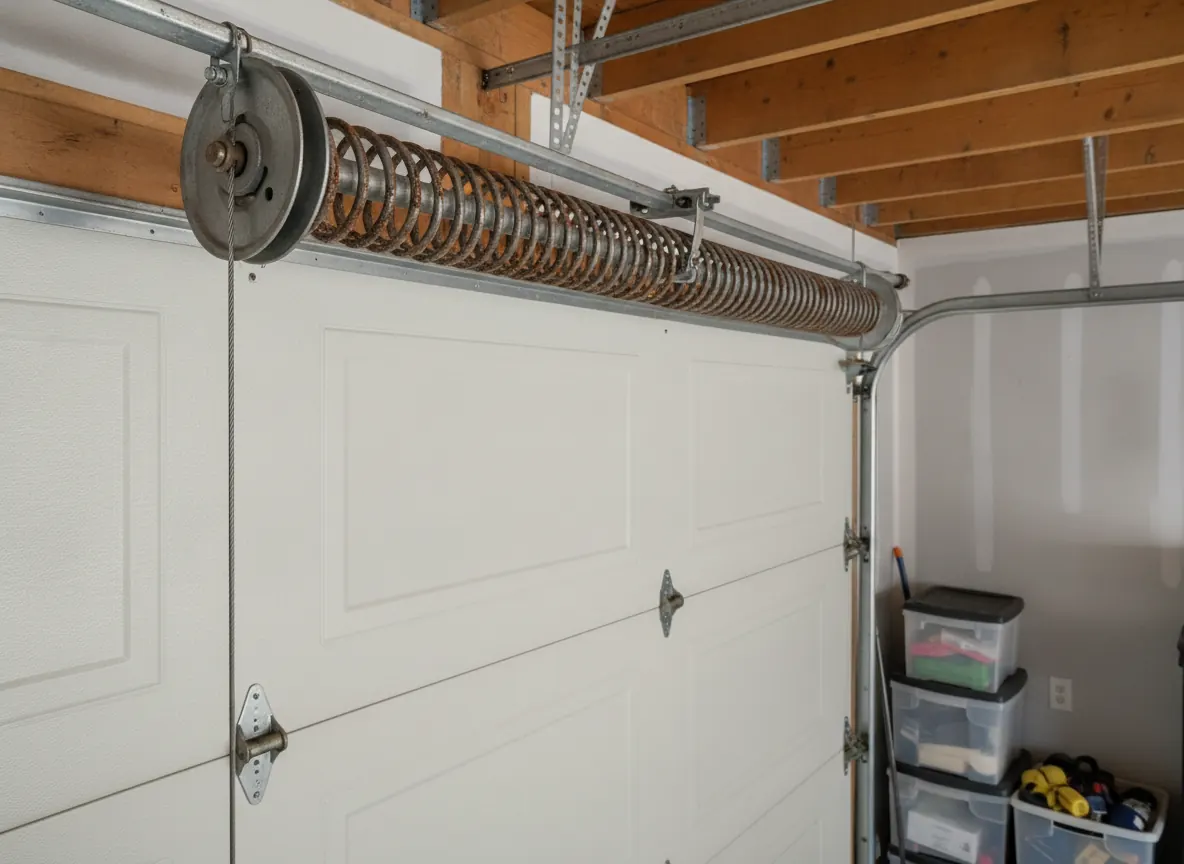
Torsion springs sit on a steel shaft above the opening and wind up as the door closes. Extension springs stretch along the horizontal tracks on each side. Both guides show torsion jobs costing more: the parts are heavier, they're matched to the door's weight more precisely, and setting them takes winding bars and a careful procedure. Extension springs are cheaper, but a proper job includes safety cables through each spring so a broken one can't fly across the garage.
A long coil on a bar across the top of the opening is torsion; springs beside the tracks are extension. Mention the type when you request quotes.
One spring or two?
Many doors use a pair of springs, and usually only one has failed. The other has done the same number of cycles, so many technicians recommend replacing both to keep the door balanced and avoid a second trip fee months later. That's a reasonable suggestion, not a rule. Ask for the price of one and of two, in writing.
What else moves a spring quote up or down
- Door size and weight. A 16×7 double door needs more lifting force than an 8×7 single. Insulated doors, wood doors and doors with glass weigh more again, and the spring has to match.
- Cycle rating. Standard springs are commonly rated around 10,000 open-close cycles. Some companies offer higher-cycle springs for more money. Ask what rating you're getting and what the upgrade costs.
- Rust on nearby hardware. In a damp Seattle garage a technician may find a frayed cable or a corroded bottom bracket at the same visit. Replacing it then can be sensible, but each part should be listed separately.
- Timing. Some local companies offer evening, weekend or emergency service, often at a higher rate (Fixr: +$100–$300). Mention urgency on your request and ask about after-hours fees before work starts.
- Trip or diagnostic fee. Fixr puts a typical service call at $50–$75. Ask whether it's included or separate.
Why spring calls are common in Seattle garages
Use wears springs out. Fixr's spring table shows a 10,000-cycle spring lasting roughly 13 to 14 years at two cycles a day, 9 to 10 years at three, and 5 to 6 years at five. A household that uses the garage as its front door goes through springs much faster than one that parks in the driveway.
Age catches up with them too. Seattle's median home was built in 1976, and 22.8% of its homes were built before 1940 (American Community Survey 2020–2024). Many of those doors are on their second or third set of springs. Shoreline's median home dates to 1969 and Burien's to 1966, while Sammamish (1994) and Issaquah (2002) are reaching first and second replacements.
Damp plays a part without being the villain. Sea-Tac averages about 156 days a year with measurable rain, two-thirds of it November through March (NOAA 1991–2020 normals). The door industry's DASMA technical sheet notes that rust reduces the effective area of spring wire and can start corrosion pits where fatigue cracks grow, and that lubrication as the manufacturer directs helps a spring reach its rated cycles. No source ties Seattle's rain to a specific failure rate, so take this as context, not a prediction. The garage door maintenance page covers a lubrication routine for a wet climate.
Can you replace a garage door spring yourself to save money?
Parts alone cost far less than an installed spring, which is why the question comes up. The difference covers sizing the spring to the door, the right tools, and the risk while the spring is under tension.
Safety first: Torsion springs store enough energy to cause serious injury. Leave spring and cable work to a trained technician. If a spring has broken, stop using the opener and don't force the door up by hand. If it's closed, leave it closed and request quotes. If it's stuck open or partway, keep people, pets and cars out of the opening.
This site doesn't publish spring or cable instructions. If your car is stuck inside, the emergency garage door repair page covers safe next steps.
Washington rules worth knowing before you pay
Washington requires garage door companies to be registered with the Department of Labor & Industries (L&I) as contractors; there is an "Overhead/garage doors" specialty. Registered contractors carry a bond (at least $15,000 for a specialty contractor) and liability insurance, and must show their registration number in ads (RCW 18.27.100). Look any company up on L&I's Verify a Contractor tool. For jobs of $1,000 or more, the contractor must give you a written "Notice to Customer" before work starts (RCW 18.27.114); a typical spring job comes in under that line, but a spring job bundled with a new opener may not.
Know your rights in Washington (not legal advice)
Washington's Consumer Protection Act (RCW 19.86.020) bans unfair or deceptive practices, and consumers can recover actual damages, up to triple damages capped at $25,000, and attorney fees (RCW 19.86.090). Ask for a written estimate and an itemized invoice that lists the parts replaced, and ask for your old parts back. Complaints go to the Washington Attorney General's Consumer Protection Division; unregistered contractors can be reported to L&I at 1-888-811-5974.
Questions to ask when you compare spring quotes
- Is the price for one spring or two, and which type?
- What cycle rating do the new springs carry?
- Is the trip fee included or separate?
- Are cables, rollers or other parts included and listed?
- What warranty terms apply to parts and labor, and can you have them in writing?
- What is your L&I registration number?
- Can you leave the old springs with me?
Get quotes for your own door
A broken spring alone is rarely a reason to replace a door; replacement comes up when a rotted bottom rail, rusted-through sections or a door that won't stay balanced stack up on top of it. To get prices for your own door, describe the problem once through the free quote form or call (877) 265-2390. There's no obligation. The garage door spring repair page explains what a technician typically does on a spring visit.
Frequently asked questions
How much does garage door spring replacement cost in Seattle, WA?
Published national guides put it at about $120–$250 for extension springs and $200–$350 for torsion springs (Fixr, Jan 2025), or $300–$540 (This Old House, Mar 2026). These are estimates, not quotes. Seattle-area companies set their own prices, so compare written estimates.
Should both garage door springs be replaced at the same time?
On doors with two springs, many technicians recommend replacing both. The spring that didn't break has done the same number of cycles, and a matched pair keeps the door balanced. Ask for the price of one and of two before you decide.
How long do garage door springs last?
Standard springs are commonly rated around 10,000 cycles. Fixr works that out to roughly 13 to 14 years at two cycles a day, 9 to 10 years at three, and 5 to 6 years at five. Rust and poor lubrication can shorten that, according to the door industry's DASMA technical sheet.
Can I use the garage door with a broken spring?
It's safer not to. With a broken spring the door is far heavier than usual and the opener may strain or fail to lift it. If the door is closed, leave it closed and request quotes. If a car is stuck inside, say so when you describe the problem.