
Garage Doors on Sloped and Hillside Driveways in Seattle: Seals, Water and Uneven Gaps
Seattle, Washington is said to lie on seven hills, and a lot of its garages sit on the side of one. Driveways that drop toward the street in West Seattle, climb from the alley on Queen Anne, or tuck under the house on Capitol Hill and Magnolia all put a garage door on a floor that is not quite level and in the path of water that is looking for somewhere to go. This post covers what that does to a door, what the common fixes are, and what to tell the companies you ask for quotes.
A rule we hold to throughout: nobody can diagnose a slope, a slab or a foundation from a blog post, and this site doesn't try. An uneven gap or a door that suddenly binds can have several causes, including settlement on a sloped lot. Mention it when you request quotes.
What a sloped driveway does to a garage door
A sectional garage door is built square. The slab it closes against often is not. On a hillside lot the floor may slope side to side (one corner of the opening lower than the other), front to back (water drains into or out of the garage), or both. Three things tend to follow.
- A daylight gap at one corner. The door bottoms out on the high side and leaves a wedge of open air on the low side. Wind, leaves and rodents use it.
- Water running under the door. When the driveway falls toward the garage, rain follows it. The bottom seal, the bottom brackets and the lowest section stay wet longer than anything else on the door.
- Uneven wear. If the opener keeps pushing until the door touches the floor, the high-side corner absorbs the load first. Over years that shows up as a bent bottom section, a stretched cable on one side, or rollers that ride differently in the two tracks.
Sea-Tac averages 39.34 inches of rain and about 156 days a year with measurable rain, about two-thirds of it November through March; November is the wettest month at about 6.3 inches (NOAA 1991 to 2020 normals). That is a long season for a bottom edge to sit in a puddle. It doesn't mean a sloped-lot door will fail; it means the bottom of the door is the first place to look when something changes.
Signs worth mentioning in a quote request
- A gap under the door that is wider on one side than the other
- A gap that was not there last year
- A door that binds, hesitates or stops partway down and reverses
- Water, silt or leaves inside along the bottom edge after rain
- A soft, dark or peeling bottom rail on a wood door
- Rust on the bottom brackets or the lowest few inches of cable
- A door that is suddenly hard to lift by hand after pulling the release with the door closed
A gap that appears suddenly is different from one that has always been there. A door that was level for twenty years and now sits crooked usually has a door reason, such as a cable that slipped on a drum or a bent track, and occasionally a slab reason. A technician can tell the difference in a few minutes on site. You don't need to.
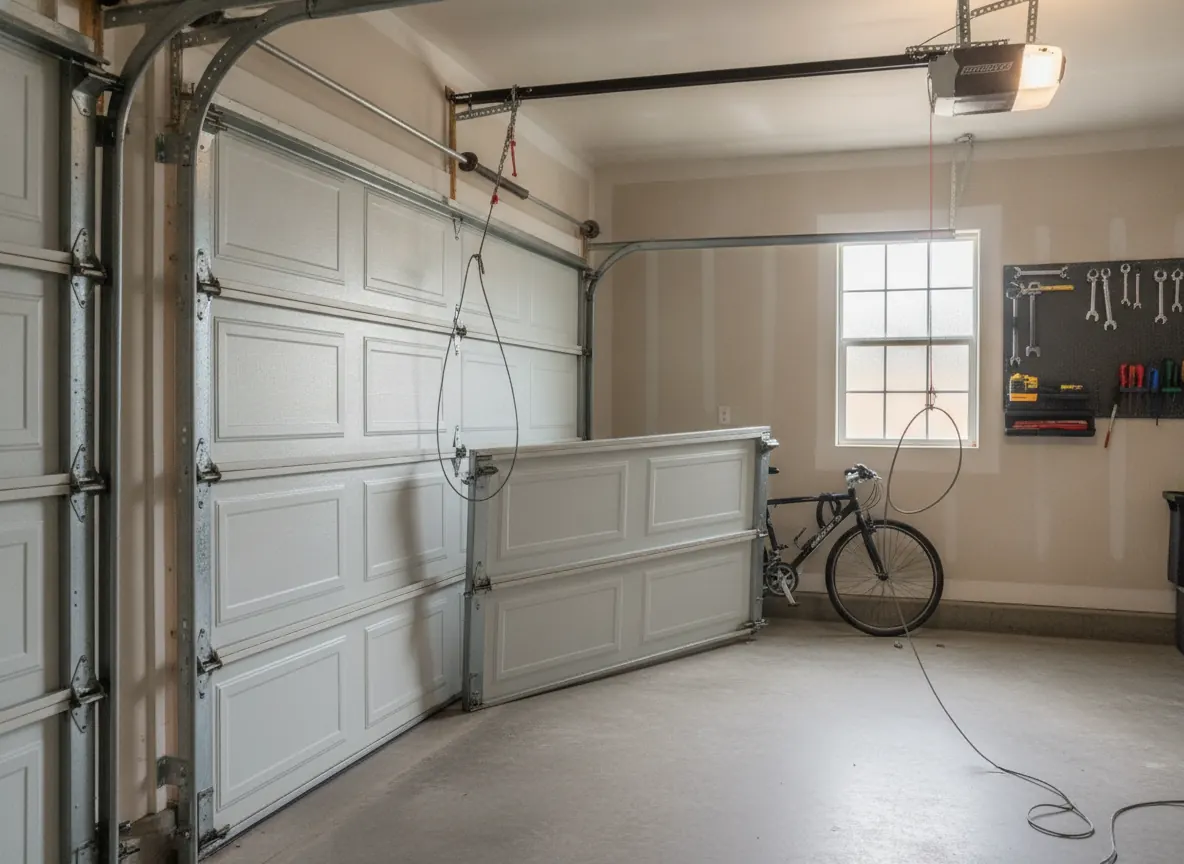
How installers handle an uneven floor
None of these are things to attempt on a door with torsion or extension springs. They are options a company may put on a written estimate.
| Approach | What it is | Typically used when |
|---|---|---|
| Taller or angled bottom seal | A deeper rubber astragal, sometimes a wedge profile, in the existing bottom retainer | The gap is small to moderate and fairly even |
| Threshold seal | A rubber or aluminum strip bonded to the slab under the closed door | Water runs in from the driveway side |
| Trimmed bottom section | The lowest section is cut or a new one ordered to follow the floor line | The side-to-side difference is too large for a seal alone |
| Track and cable correction | Rehanging a bent track, reseating a cable, replacing worn rollers so the door closes square | The gap is new, or the door binds |
| Replacement door | A new door ordered to the opening, with the slope measured | The bottom section is rotted or bent and the door is old |
Published national guides give ranges for the repair side of that table. Off-track repair runs $100 to $300 and cable repair $100 to $200 (Fixr, January 2025) or $170 to $320 (This Old House, March 2026), with a service call or trip fee of $50 to $75 (Fixr). Custom seals and trimmed sections are quoted per job. The full list is on the cost guide; it is labeled as published estimates, not quotes, and Seattle-area quotes vary.
Safety first on a binding door
Torsion springs store enough energy to cause serious injury. Leave spring and cable work to a trained technician. If the door binds, don't force it with the opener; repeated attempts can pull a cable off its drum. Every opener made since 1993 has a red emergency-release handle (16 CFR 1211.9). CPSC says to pull it only with the door closed, then lift by hand; if the door feels heavy, won't stay up, binds or slams, stop and call a company, because that points to a spring problem.
Tuck-under and basement garages
Hillside lots in Seattle often put the garage under the living space, with the door opening onto a short, steep apron. These doors live in a damper spot than a detached garage at the top of a flat lot: shade, close retaining walls and water coming off the driveway. Wood doors here show it first. Rot usually starts at the bottom rail where the end grain sits on wet concrete, and a bottom rail that is soft to the thumb is a panel-replacement or full-replacement conversation rather than a seal conversation. Steel doors fare better, but the bottom brackets, hinges and cable ends are the first hardware to rust. Galvanized replacement hardware is worth asking about on any repair.
If the door is already off its track
A door that has been binding on an uneven floor can eventually jump a track, usually after a cable goes slack on one side. Stop using it. A section out of its track with a slack cable is one of the situations where a second attempt with the opener makes the repair bigger. The off-track repair page explains what a technician typically does and what to expect on the estimate.
Questions to ask the companies that reply
- Is the gap the door, the track or the floor, and how can you tell?
- Which fix are you proposing, and what happens if the slab keeps moving?
- What is the L&I registration number, and is the trip fee stated on the written estimate?
- Are the replacement brackets, hinges and cable ends galvanized?
- Will the bottom seal be a standard or a custom profile, and is it in the price?
- Can I have the old parts back, and are the warranty terms in writing?
The Garage Door Repair Seattle is a free quote-matching service, not a garage door company. Describe the door, the gap and the slope once in a free quote request, or call (877) 265-2390, and independent companies serving Seattle, WA and the Eastside can reply with no-obligation quotes.
Frequently asked questions
Why is there a gap under one side of my garage door?
An uneven gap or a door that suddenly binds can have several causes, including a worn bottom seal, a bent track, a cable that has slipped on one drum, or settlement on a sloped lot. A garage door company can tell you whether it is the door, the track or the slab. Mention the gap and the slope when you request quotes, and don't adjust springs or cables yourself.
Can a garage door be fitted to a sloped floor?
Yes, in several ways. Installers commonly use a taller or angled bottom seal, a threshold strip glued to the slab, or a bottom section cut to follow the floor. Which one fits depends on the size of the gap and the door type. Ask each company what they recommend and why, and ask for it on the written estimate.
How much does it cost to fix a garage door that binds or won't close on a sloped driveway?
It depends on the cause. Published national guides put off-track repair at $100 to $300 and cable repair at $100 to $200 (Fixr, January 2025) or $170 to $320 (This Old House, March 2026), plus a typical $50 to $75 trip fee. A custom seal or trimmed section is quoted job by job. Seattle-area quotes vary; get them in writing.
Does rain running under the door on a slope damage the door?
Standing water at the bottom of a door keeps the bottom seal, bottom brackets and the lowest section wet. Sea-Tac averages about 156 days a year with measurable rain (NOAA 1991-2020 normals), so a wet bottom edge is a real wear point for wood doors and painted steel hardware. A better seal helps; a drainage question belongs with the company you hire.